

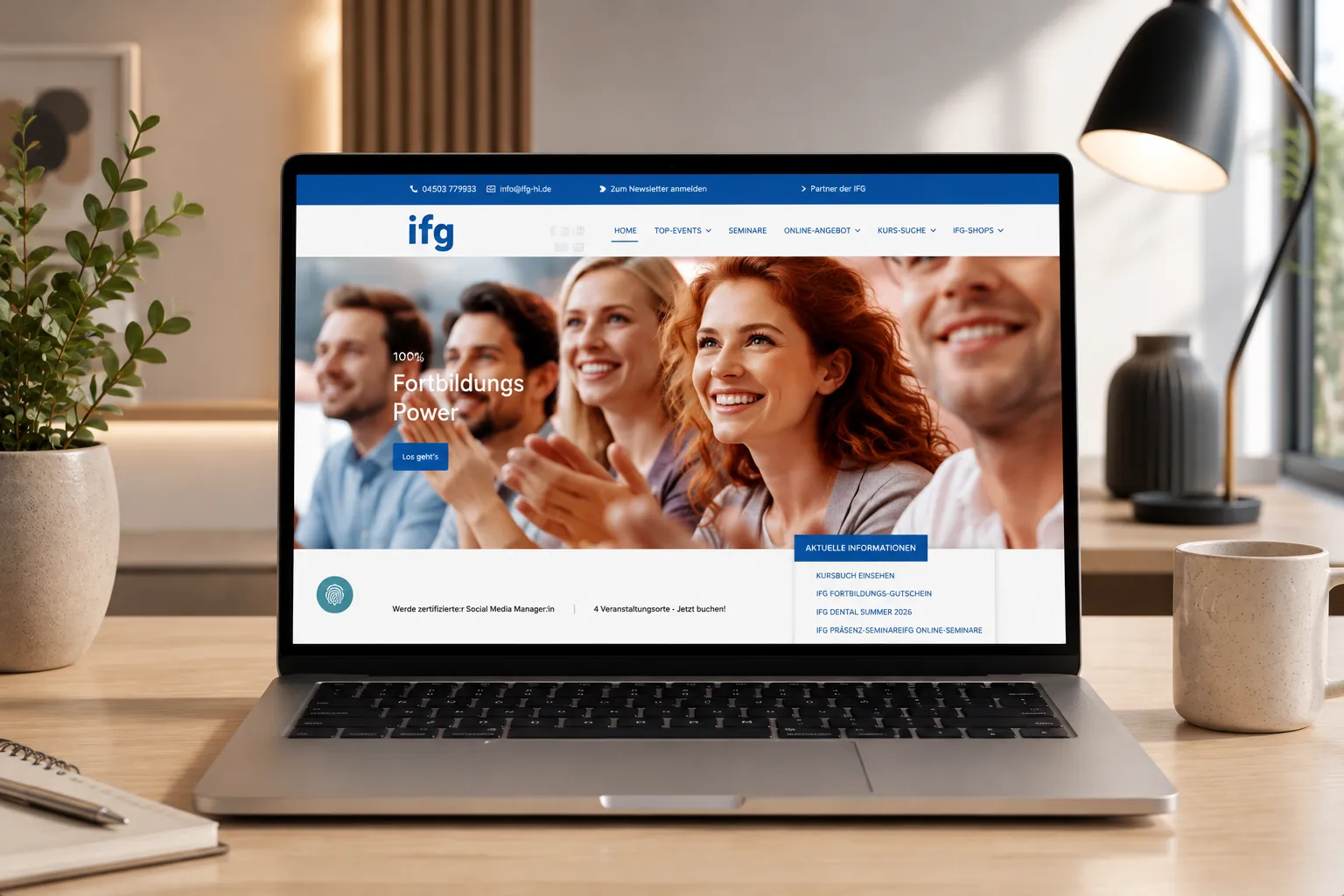
IFG has been training dentists and practice teams since 1978. Over the years almost every course series had grown its own web presence, more than 50 in the end, each with its own audience, its own bookings and its own customer data. The relaunch turned all of that into one platform: one login, one course catalogue, one way to book. My part was the design side – making one handwriting out of many, without long-standing customers feeling like strangers.
The starting point: reach spread across more than 50 addresses
In 48 years more than 100,000 participants have attended IFG courses. As a state-recognised, AZAV-certified provider it covers the full professional spectrum today: from aesthetic dentistry through endodontics, implantology and prosthetics to practice management, orthodontics and communication.
The programme has grown over decades. From 2019, online webinars were added during the pandemic, and each event, course series and location got a web presence of its own, putting its topic centre stage and speaking directly to its audience. As the programme succeeded, the number of these sites grew, ending at more than 50 independent instances. Each had its own audience.
These sites were not shop windows but platforms: on-site and online seminars were booked through them, so every instance held customer data as well. What had grown over the years was above all one thing – a large, actively used reach. Bundling exactly that was the point of the relaunch, alongside a second goal: less maintenance. It had grown with every installation, and security requirements have not become smaller since.
The whole programme has to stay findable
Every course previously spread across separate sites had to be findable again in one shared structure: the 50-plus online seminars that now run on the platform itself, the on-site courses in Hamburg, Düsseldorf, Munich, Frankfurt or Berlin, and the special events, for instance on Mallorca and in Ischgl.
Booking is for the team, not for one person
At IFG, training is a team matter; a large part of the programme is aimed explicitly at the whole practice team. So a dentist books for several employees: sometimes for the team and themselves, sometimes only for staff, sometimes several events with different people, and the number of participants varies. The booking process had to handle all of that cleanly – without anyone guessing where to enter the second name.
Carrying familiarity across
The individual instances sometimes looked markedly different from the main site, and many customers had been familiar with their site for years. That trust was exactly what the relaunch had to carry across. Anyone who had worked on a particular site should find their way around the new platform immediately, and not feel they had landed on a stranger's website.
The solution: one platform, one login
Merging meant one instance with one user account and one shared course catalogue. User data and bookings from the old systems were migrated and consolidated; for existing customers without an account we created logins. In their account, customers now see their current courses – booked on-site seminars as well as the online seminars that run on the platform itself.
The booking process was designed so that registering several people is not a special case but was thought through from the start. People booking name their participants in a flow that works without explanation. In everyday use it runs smoothly today.
The catalogue is organised by specialist field, so the broad programme can be searched with purpose. The big dates of the year – the Best Day in Düsseldorf, the Forever Young workshops or the Mallorca seminars – are featured prominently as top events and still remain part of the same catalogue.
Design: consolidate without losing anything
In design terms the task was to make one visual handwriting out of many, without users feeling lost. The characteristics of the previous instances were therefore not simply deleted but translated into the new system: as recognisable elements within a shared design language. The origin of a section stays visible, while the whole presence reads as consistent.
Two event brands with addresses of their own
Two flagship events have a brand domain and a standing of their own in the industry: Dental Summer in June at Timmendorfer Strand and Dental Winter in January in Ischgl. Both were built in the look of the new platform as well. They keep their own address and brand presence, and are still clearly part of the same world.
Technology: Joomla! with few extensions
The technical side was in the hands of Benjamin at Wicked Software: migrating the legacy systems, consolidating user data and building the booking logic. The platform runs on Joomla!, moving from version 3 to 6 in the process. Using the permissions system, custom fields and overrides, several maintenance-heavy third-party extensions were replaced by core features – exactly the lever for the goal of reducing maintenance. The admin area was tidied up and tailored to what the editorial team actually needs.
Working together
The project was demanding and needed technology and design to interlock closely throughout. On the client side the collaboration was genuinely pleasant: short decision paths, quick and clear feedback. In a project carried out alongside day-to-day business, with revenue depending on it, that is a decisive factor.
The result
More than 50 separate instances have become one platform with room for IFG's entire programme – scalable and extendable with new features without rebuilding.
- One login for every user, existing customers included, even those who never had an account
- One continuous course catalogue across all formats and fields, online and on site
- A booking process that reflects how practice teams actually book
- A consistent design in which the former instances and both event brands stay recognisable
- One central system that can be kept up to date continuously, and stays well protected because of it
The platform is live at ifg-fortbildung.de.
Frequently asked questions about merging several websites
When is it worth merging several websites into one platform?
Once every single site has to be maintained, updated and secured, the effort grows with each installation. Add user accounts and bookings, and the customer relationship is spread across many addresses as well. A shared platform reduces maintenance, concentrates reach on the main brand and turns security updates into one job instead of fifty.
Do user accounts and bookings get lost when sites are merged?
They don't have to. In this project, user data and bookings were migrated from the old systems and consolidated, so everyone finds their login and their booked courses after the switch. For existing customers who had booked without an account, logins were created.
How do familiar individual sites stay recognisable when everything becomes one?
By translating rather than deleting what made them distinctive: as recognisable elements within a shared design language. The origin of a section stays visible while the whole presence reads as consistent, and nobody feels they have landed on a stranger's website.
Can event brands keep their own domain?
Yes. Dental Summer and Dental Winter kept their own addresses and were built in the look of the new platform. They keep their brand presence and are still clearly part of the same world.
How do you book courses for several people from one team?
The booking process is designed for several participants from the start, not retrofitted as a special case. People booking name their participants in a flow that works without explanation – for the team and themselves, for staff only, or for several events with changing groups.